Tea History: Multiple Infusions


I was recently approached by the U.S. National Archives Dept. and asked to contribute a few words for a new exhibit on tea and early Philadelphia. The exhibit, based in the Philadelphia Archives Building, has since been completed and opened to the public through November 2005. I'm honored to have been chosen to appear in the exhibit's catalog along with two tea heavyweights, James Norwood Pratt and Diana Rosen.
After attending the opening of this exhibit, I was truly amazed by how much detailed information and interesting artifacts the folks at the Archives were able to recover and portray in such a comprehensive way (special thanks and congratulations are due to Robin Morris, the multi-talented curator of this fine exhibit).
As a result of this success, the folks at Adagio have urged me to re-print my article in this month's TeaMuse for the edification of all tea lovers that may not be able to attend the exhibit. So, without further adieu, I present "The Opium Wars: thirst and addiction."
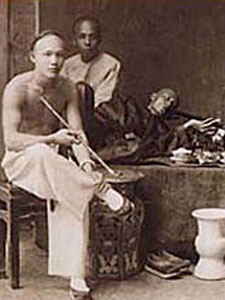
In all the tales in the tome of tea, there is no sadder chapter than that of the Opium Wars. The suffering and misery of these conflicts nearly crippled an entire empire and afflicted almost four generations. This is the story of the unconscionable lengths a country went through to fulfill a demand. In this war, the most damaging weapon was not a sword or a gun or a bomb, but a drug.
In 18th and 19th centuries, England was willing to spend vast sums of money on tea. But there were problems: physically taking such large amounts of money out of England to pay for tea would have collapsed the country financially. More practically, it would have been impossible to transport all that money halfway around the world safely to China. The situation was further confounded in that, while consumers of the West desired tea and other goods from China, England was unable to find anything China wanted for which to trade.
It was thanks to England's unquenchable thirst, and the resulting duplicity, that the world's largest, most powerful monopoly was born, the British East India Company. Also known as the John Company, it began as a commercial venture intimately associated with the British government and ended up practically ruling India. It was there that England, through the British East India Company, saw the solution: they could grow the inexpensive crop of opium in the newly occupied land and use it as a means of exchange for Chinese tea and goods.
Because of its addictive nature, the demand for opium was enduring. This resulted in lifetimes of addiction for the Chinese, but insured a practically endless supply of tea and goods for the British East India Company and, consequently, England.
The Chinese government tried to maintain a forced distance between their people and the opium distributing "devils". One Chinese noble even wrote an eloquent and moving letter to the Queen of England herself, begging for an end to such indecency. Sadly, the letter was never delivered and the English, with a far superior military force, went to war for "free trade" (the right of the British East India Company to continue to sell opium).
By 1842, England had amassed enough victories to sign the Treaty of Nanjing with China. This not only forced China to relinquish rule of Hong Kong over to the British, but also ensured the British East India Company's continued sale of opium, undisturbed, until 1908.
While the two main players in this engagement were China and England, other countries had peripheral roles. France and the United States also played a role in this tragedy. In fact, Philadelphia itself was not out of reach of the Opium Wars' iniquitous arms.
Stephen Girard, a long-time Philadelphia resident and one of America's first millionaires, is generally remembered as a hero. During his residence in Philadelphia, he loaned millions of dollars to the US Government, instrumentally aiding in the War of 1812. He also contributed to many local and national charities (including a college for orphans which became Girard College), and even helped fight a yellow fever plague.
In Mr. Girard's early career, he also dabbled in the Chinese opium trade himself. Once Chinese military resistance began to increase, however, his interests quickly diminished and he was out of the game before the War officially began. During this time, though, he did accrue a solid profit - a strong foundation for which to build his fortune. In fairness to Mr. Girard, once he received word of the accounts of the suffering and addiction plaguing the Chinese people, he made a publicly concerted effort to avoid directly the trading with opium in any of his trade ventures.
However, it was Girard's bank, appropriately called The Girard Bank, which was the Philadelphia representative of the Baring Bank. This bank was the US account holder of the British East India Company. Girard made millions on this relationship alone.
By the middle of the 1800's, millions of Chinese people, one in every three adults, were caught in the grasp of opium addiction. The effects of this affliction were so widespread that the economy of China, once prosperous and wealthy, went bankrupt for nearly twenty years. And this was all catalyzed by a tenacious thirst for tea. So the next time you are enjoying a "Green Tea" Frappuccino on a lazy Sunday afternoon, remember: the life of tea has not always been so sweet.