
Tea Culture in America: Convenience
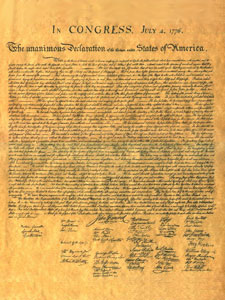


On July 2, 1776, America boldly chose to separate from the oppressive British Empire. Congress made it official two days later, adopting the Declaration of Independence. The country began to grow at breakneck speeds, quickly becoming one of the richest, most powerful nations in the world. This abrupt succession of power did not come merely through brute force, however, but through technological innovation.
It is also through the use of technological innovation that lead America to become one of the major progressive forces in the tea world... Not bad for a country that only produces a negligible amount of tea itself. In this month's patriotic installment of TeaMuse, we'll explore just how much of an impact America has had, and continues to have, on the tea industry.
Invention is generally born out of necessity. Such is true of America's innovations in tea. Most of these contributions grew out of a need to make tea more convenient. The following are some of the more significant examples of America's impact on tea.
By the early 1900's, America stabilized her government, strengthened her economy, and expanded her borders and interests. The United States was now ready for the world to see her development at the 1904 World's Fair. Trade exhibitors from around the world brought their products to St. Louis. One such merchant was Richard Blechynden, a tea plantation owner. Originally, he had planned to give away free samples of his tea (hot tea) to attendees. But when a heat wave hit, no one was interested. Parched from the temperature, visitors would pass his booth in search of a cooler refreshment. To save his investment of time and travel, he dumped a load of ice into the brewed tea... and thus popularized "iced" tea. Today, nearly 90% of all tea consumed in the US is in the form of iced tea.
Before the 1900's, tea was only available as loose leaves. Thomas Sullivan, a tea and coffee merchant from New York City, tried to cut costs by sending samples of loose tea in small silk sacks instead of costly tins (which was what most merchants used at the time). Potential clients, confused by this new packaging, threw the tea in hot water—bag and all. Thomas started getting many requests for these "teabags" and realized that he had struck gold. The quick and easy clean-up of the leaves (due to the fact that they were still contained in the silk bag) made it enticingly convenient. Teabags first began appearing commercially around 1904 (obviously a milestone year for American tea!), and quickly shipped around the world.
In 1948, Nestle USA produced a powder from which, when it was mixed with water, would produce a tea-like product. This product, which became known as Nestea (still around today), was marketed as an "instant tea" that both simplified the preparation process and made it easy to store large amounts. However, it should be kept in mind that tea is usually a relatively a minor ingredient in most instant teas. Typically, sugar is the primary ingredient, then flavorings, coloring agents, anti-caking agents, etc.. In fact, most instant teas do not even contain real tea, rather tea extract. All criticisms aside, one must not fail to appreciate the success of instant tea has enjoyed and recognize that it is a product which has its roots in tea.
However, we still haven't touched upon what is quite possibly America's most significant contribution to the tea world. This comes from a seemingly unlikely source: former US Vice President (and "Fahrenheit 9/11" co-star) Al Gore. Among Al Gore's many impressive accomplishments, he claims to have played a crucial role in the creation of the World Wide Web. This enabled individual consumers and businesses to easily have access to a tremendously large network of information and commercial enterprises. Many progressive tea companies realized that, through the utilization of the internet, they could quickly and easily supply customers across the globe with fresh, gourmet-quality tea. Luckily, you've already found the perfect example of this innovation - adagio.com!
Finally, we'll conclude this month's episode of TeaMuse with a little known fact about tea and American history:
Thomas Jefferson loved tea so much that he constructed a polygonal tearoom adjoining the parlor of his Monticello home. He referred to this room as his "most honorable suite" because it was in this uniquely designed tearoom that, between June 11 and June 28, 1776, he wrote and edited the Declaration of Independence.