Brief Introduction to Korean Tea
Like its Pacific Rim neighbors, Japan, China, and Indochina, Korea is also a tea-drinking country with a rich ceremonial tea culture. Also like them, Korea owes its tea heritage to the enthusiasm and devotion of Buddhist monks who traveled the globe spreading the opportunity for enlightenment and the special alertness that tea contributes to the meditation process.
Tea drinking in Korea most likely began with a beverage made from tea seeds brought from China during the Silla Dynasty (57 B.C.-A.D. 668) although legend has it that the Chinese teas were replaced by a native tea plant known as Paeksan-ch'a, a white mountain tea which grew on Mt. Paektusan and is said to be as old as Korea's Ko-Chosun era (2333-108. B.C.). Today, this tea is still drunk in the hills of the Mt. Paektusan and the surrounding area.
Tea has had an up and down life in Korea. During its Koryo Dynasty (10th to 14th centuries) tea played a part in many aspects of its culture, poetry, drama, art and song, and was served in a ceremony known as Ch'a-rye. Although the name means "tea ritual" the drink offered has not been tea for centuries past, but instead rice-wine is offered. Another ceremony, Hon-ta, was part of the Buddhist tradition in which green tea was offered to the Buddha resting in local temples. It, too, is rarely observed today.
Buddhism was supplanted by Confucianism during the Choson Dynasty of the fourteenth century, and with that critical change, the taste of tea went out of favor. It slowly crept back only to be usurped in the late sixteenth century when Japan invaded the country. The invasion by Japan in the 1590s was unprecedented; there had been nothing like it before. In an ironic twist, Korean potters forced to work in Japan produced some of the finest tea bowls for chanoyu, many of which are now considered priceless treasures.
Early in the nineteenth century it took a scholar with a passion for formalizing tea in his own special tea room to reintroduce the culture of tea in Korea once more. Chong Yak-Yong (1762-1836), a disciple of monks at temples near Kangjin, was instrumental in forming a tea lovers' society while in exile in Chollanam-do province. There, he and his disciples grew tea and even years after he left, tea flourished in the area. He is often referred to as Tasan or Tea Mountain, an apt name for such an influential tea lover.
One Buddhist monk made an indelible mark on Korean culture during the late Choson period: Ch'o Ui (1786-1866). Not only did Ch'o Ui write about tea, he wrote about all elements of it from how it grew, how it was produced, how best to prepare it, and tea's healthful benefits. The book, "Tongdasong" or "Ode to the Korean Tea" was followed by another classic, "'Tashinjon" or "Lives of the Tea Gods." He was known to be a frequent tea drinking companion of Tasan with whom he stayed in his youth before going on to become known as the restorer of the Korean Way of tea.
Panyar-o Recent decades have seen a regeneration of interest in the Korean way of tea, thanks primarily to Hyo Dang, Ch'oi Pom-sul, the great restorer of tea for the 20th century. He wrote the first book on tea to be published in modern Korea, "The Korean Way of Tea," and was a renowned teacher of the Korean way of tea. Hyo Dang chose a more natural style of ceremony and gave the name Panyar-o, the Dew of Enlightened Wisdom, to the green tea he made. This name is also used for the form of tea ceremony he taught.
Much of this tradition was subjugated from the early 1950s to barely a decade ago but fortunately for all tea devotees, the tradition and the beauty of Panyar-o is flourishing among young and old in modern Korea which is only now beginning to appreciate its tea and tea ceremonies and its accompanying tradition of creating the pale celadon pottery for use as vessels for tea.
Female Tea Masters Men are not the only devotees of the ceremony; Great Tea Master Chae Won-hwa studied with Hyo Dang for ten years and is his accepted successor. She continues to conduct Panyar-o at the Panyar-o Institute for the Promotion of the Way of Tea in Seoul where she continues to teach the tea culture of the Venerable Hyo Dang.
Tea Serving Accoutrements Although Hyo Dang believed that drinking tea alone was the best of all, the typical tea set of Korean ceremony (ch'a-gi) includes three to five cups (ch'at-chan) along with a small teapot (ch'akwan) larger than Chinese Yixing pots but considerably smaller than European ones.
Hot water is poured into the cups and the teapots to warm them, then that water is discarded into a large bowl (kaesukurut). Additional water is heated, then cooled in a smaller lipped bowl (mulshikim sabal) prior to pouring it over the tea in the pot to be infused. The smaller lipped bowl is refilled with hot water in anticipation of subsequent infusions.
After tea is steeped, it is poured into the cups which are then placed on small saucers (patch-im). The host then places a cup and saucer before each guest. Guests enjoy first the color of the tea, then its fragrance. Using both hands, they hold the cups to drink the tea, first observing the taste in the mouth and down the throat, then its after-taste, again in the mouth. Korea observes taste sensations of sweet, salt, bitter, tart and peppery, with many gradations in between for its cuisine and for tea. Subsequent infusions are made and the liquor poured into the lipped bowl which is passed around the guests who serve themselves rather than the host continuing to serve.
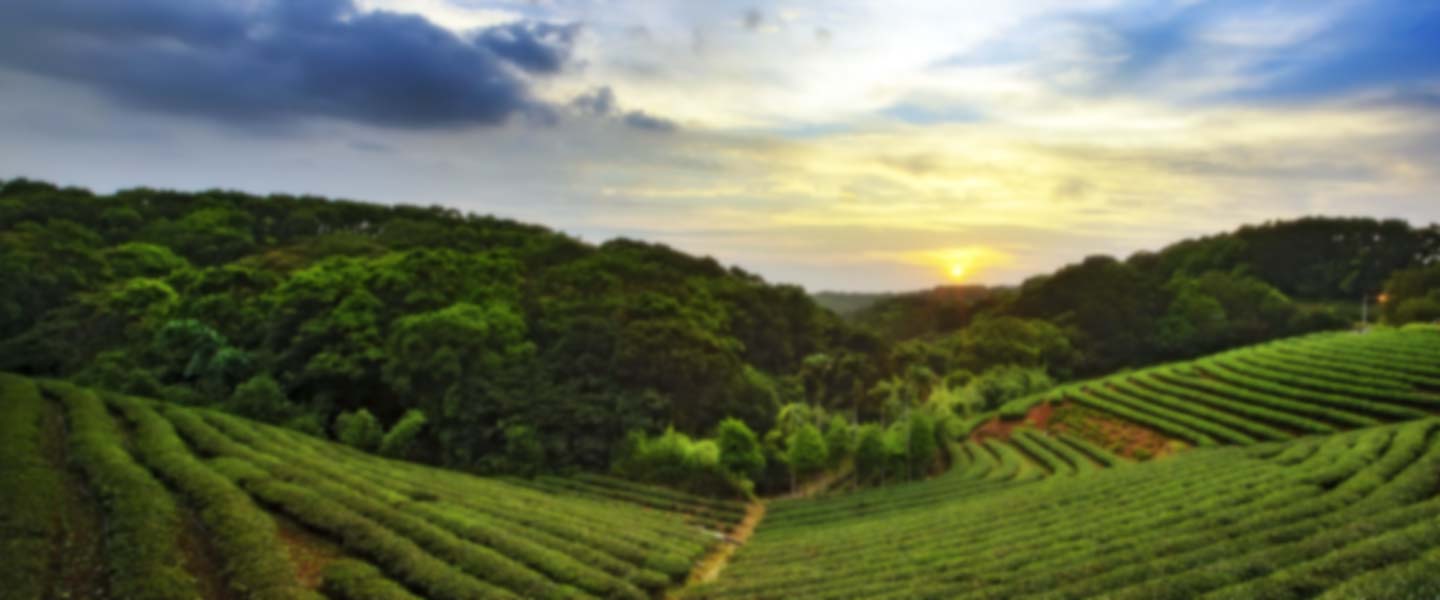
In Korea, tea bushes can only be grown in the southernmost part of the country. The finest tea comes from the slopes of Chiri Mountain, but other tea plantations can be found in Posong near Kangjin, Wolch'ul-san, and Cheju-do island. Tea is first plucked on or just before April 20 (ujon), followed by those plucked May 5-6, (ipha). Those tea leaves collected between the two primary dates are called sejak. After the season, teas gathered are known as chungjak. Because the tea produced in Korea is so modest, many tea plantation owners pluck continuously, thus blurring irrevocably the types of teas forever. Also, because Korean tea is available in such limited quantities, Japanese greens are frequently used.
Among the sources for this article was Brother Anthony (An Sonjae ) of Sogang University, Seoul, Korea. We are grateful for his contributions. For more information about Korean tea, please access Brother Anthony's website at http://hompi.sogang.ac.kr/anthony/kortea.htm